
First Asian designer to exhibit an artwork
at the Domaine National du Palais-Royal
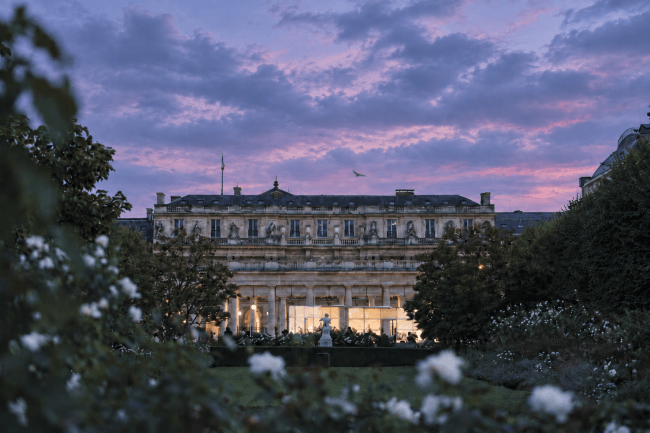
Wu Bin, founder of W.DESIGN, has been invited by the Ministry of Culture of France·Centre des monuments nationaux to present The Pavilion of Time, a new installation from his Travelogue on Mountains series, at Paris Design Week 2026 (September 10–17). He is the first Asian designer ever to exhibit in the historic Domaine National du Palais-Royal.
 |
|---|
Public space is the vessel of a city’s spiritual life. The City of Paris has long supported art as a means to invigorate urban space, awaken everyday perception, and enrich the spiritual texture of city life. The Pavilion of Time is precisely such a practice. Situated in the 17th-century Domaine National du Palais-Royal, adjacent to the Louvre, it occupies a significant coordinate on Paris’s historic axis. As an Eastern perspective enters this courtyard for the first time, it brings to Parisian daily life a different experience of time—and during Paris Design Week, becomes a scene within Parisian life itself.
The Pavilion of Time
People habitually say “check the time,” yet rarely “feel time.” How to feel time is the question The Pavilion of Time seeks to pose.
Thus, “Time” refers to rendering the shape of time as bodily experience—through the shifting of sunlight and the rise and fall of footsteps; “Pavilion” is the interface between humanity and nature, where one senses the passage of existence and the presence of the present.
 |
|---|
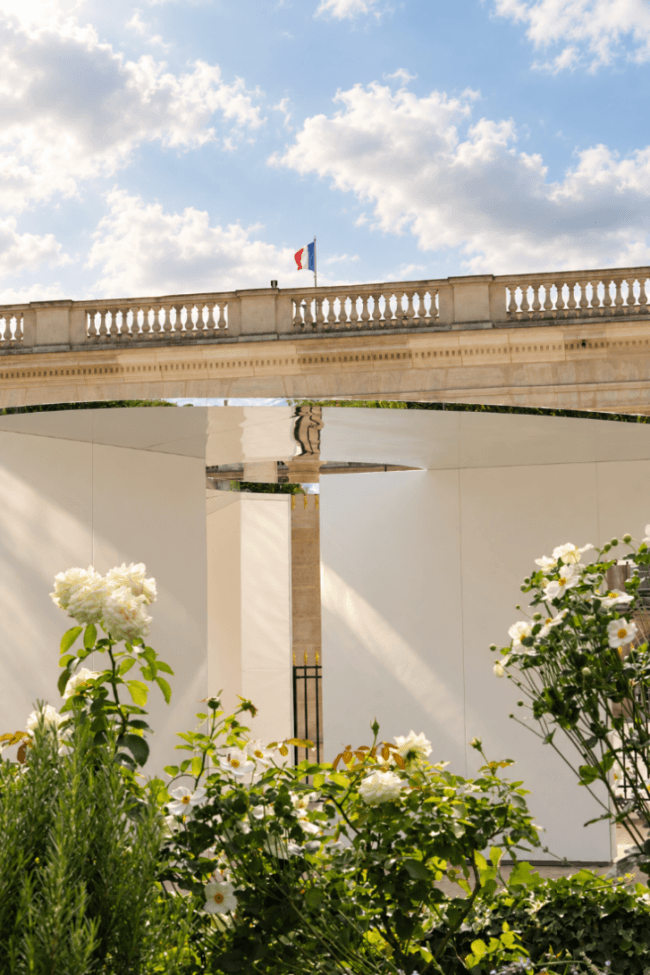
The circular installation stands within the Domaine National du Palais-Royal, surrounded by the orderly, orthogonal classical architecture. This mirrors the two attitudes toward time held by East and West: the West builds in stone to achieve eternity, resisting time’s erosion; Eastern architecture favours wood, acquiring patina, weathering, and eventually decaying under time’s embrace.
A temporary space therefore possesses a peculiar state: its existence is brief, and so the moment one encounters it becomes all the more precious. This also allows us to discuss “time” more directly.
Permanent architecture endures over time, whereas a temporary structure—from its appearance and use to its eventual disappearance—forms a complete process in itself.
A Scene Within Parisian Life
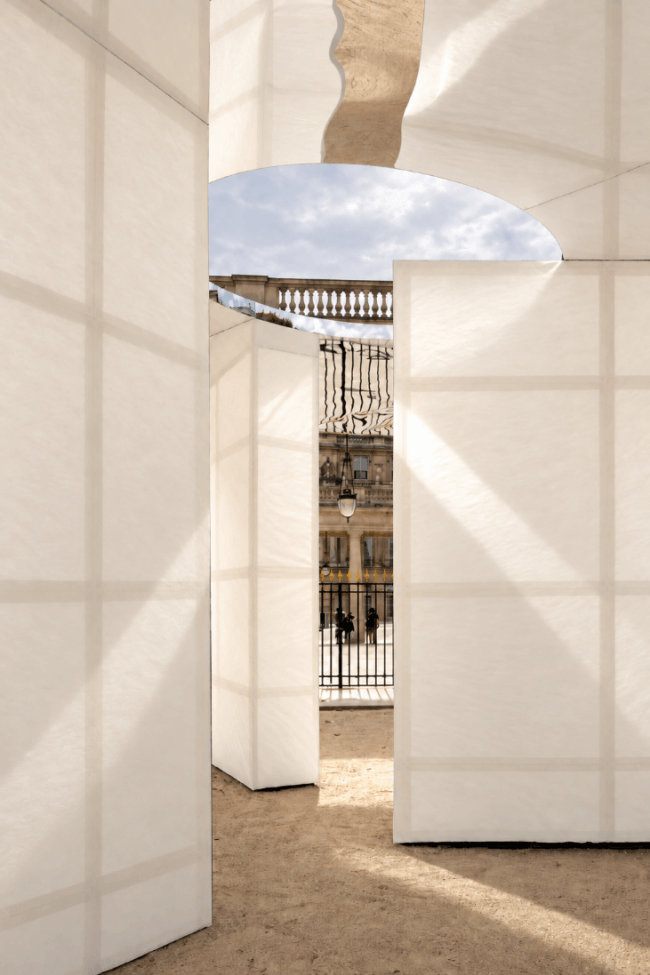
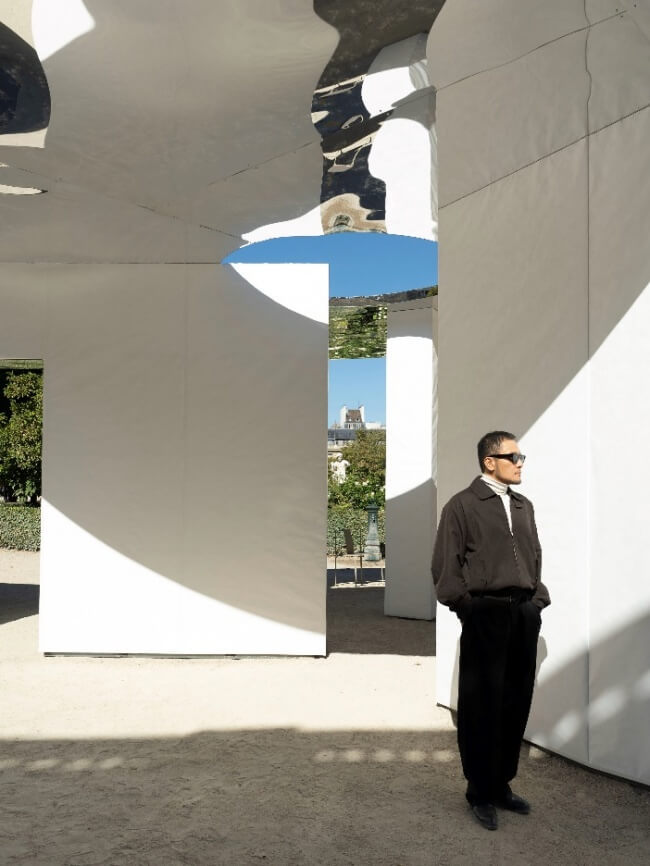
The Pavilion of Time comprises three paper-like walls of differing lengths, supporting a mirrored circular roof. Seen from above Paris, the lengths of these three walls correspond to the relationships between the hour, minute, and second hands—a universal expression of timekeeping. Sunlight, passing through the circular opening in the roof, casts a slowly drifting trail of round light patches across the walls and floor. In that moment, an ancient sundial seems to emerge within the garden.
 |
|---|
Two expressions of time meet within a single courtyard.
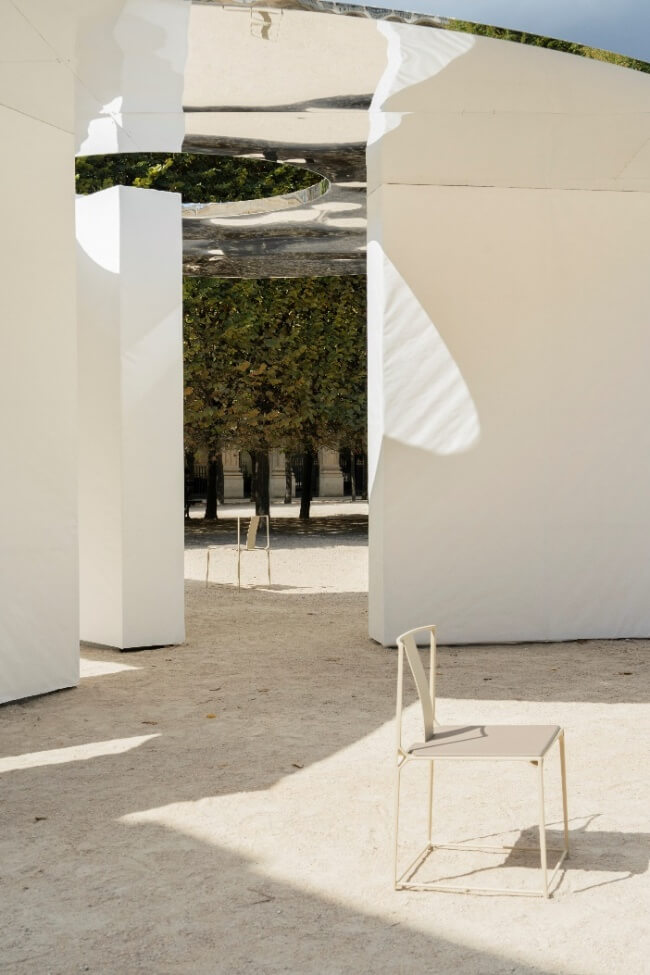
We hope that everyone who enters will feel that they are within time—that you and I are time itself. Thus, we have opened apertures in each of the three walls, allowing people to pass through; and we have placed light seating around the periphery, inviting pause—to sit with time, with the movement of light and shadow in this very moment. When a patch of light falls upon the back of a hand, time acquires a visible shape.
When The Pavilion of Time meets people, it ceases to be an installation and becomes part of Paris. Someone raises a camera, trying to hold a moment of light; someone kisses beneath the arc, as if time had stopped at the lips; a dog walker slows down, letting the dog circle the ring; a runner passes through from the far end of the courtyard and disappears into the garden’s depths—this is Parisian daily life. They step in, treating The Pavilion of Time as a perfectly natural scene within Parisian life.
 |
|---|
At this moment, time is no longer recorded by clocks. Under the Eastern understanding of time, these subtle encounters become touchable, shareable, and memorable. The Pavilion of Time returns time to life, and life, here, returns a concrete romance.
A “Timeless” Courtyard
This year’s Paris Design Week theme, “Pulse in Motion,” points to the kinetic energy of imagination in constant flow. In uncertain times, design should be a response to the future—re-establishing connections between people and the world: intimacy between people, harmony between humanity and nature, and a composed coexistence between people and time.
What The Pavilion of Time does is make these connections concrete: one enters, the body perceives the changing space and time, and time becomes a series of perceivable moments. These moments foster closeness, pause, and reunion among people, and give rise to richer sensory memory.
 |
|---|
All of this takes place within this “courtyard” in the Domaine National du Palais-Royal, allowing time to be perceived and people to embrace life itself. From the moment the work is completed, it no longer belongs to the designer—it belongs to everyone who enters. To let Parisians pause here and feel a moment of tranquility and joy—this happiness is the meaning of The Pavilion of Time, and the gift it brings to Paris.

Location: Domaine National du Palais-Royal
Dates: 10–17 September, 2026
Artist
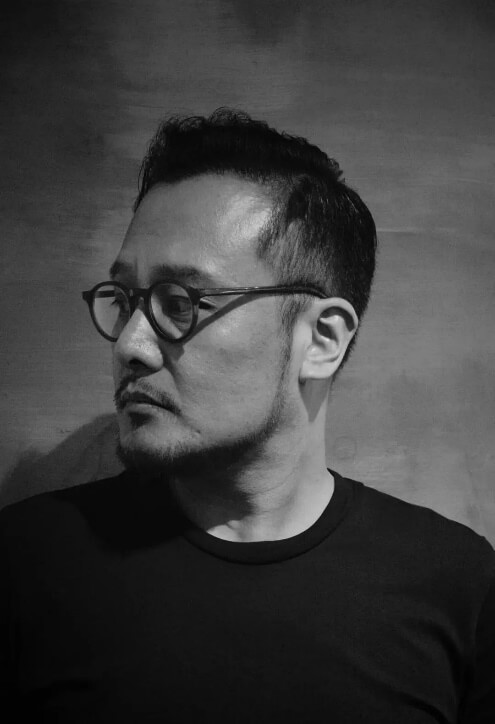
Wu Bin, the founder of W.DESIGN and a renowned designer, has extensive experience in interior, architectural, and product design. He is known for pioneering the " Timeless East " design language. Wu Bin was honored with "Designer of the Year" award at the 24th Andrew Martin International Interior Design Awards, becoming the first designer from mainland China to receive this accolade.
Additionally, Wu Bin has been featured in AD100 by Architectural Digest China for seven consecutive editions, awarded the EDIDA International Design Award as China’s Designer of the Year, Dezeen Interior Designer of the Year, and recognized as one of China’s Top 10 Designers by the China National Interior Decoration Association. He has also been acclaimed by leading Chinese media as "a pioneer of the era."
Partners Profile
The realization of The Pavilion of Time was supported by three leading Chinese brands—M77, Moorgen, and SHANG XIA. Each brings its own field of expertise, converging here through a shared attention to Eastern aesthetics and contemporary craft, allowing The Pavilion of Time to be perfectly presented at the Domaine National du Palais-Royal in Paris.

Since 1991, M77 has integrated design, research, and production, with consolidated experience in the luxury hotel industry. In 2014, it entered the custom residential cabinetry segment with the M77 brand, combining Eastern aesthetics and Western techniques to create customized solutions, including doors, paneling, storage systems, and home automation. The Genslyn sub-brand, managed by Wu Bin, interprets the new luxury living experience, offering a contemporary and refined aesthetic.

Founded in 2016, Moorgen Group is a world-leading smart home manufacturer. The company develops more than 1,200 intelligent products capable of local and remote visual control, powered by self-developed bus control technology, wireless control technology, and cloud computing. Moorgen's smart products have won numerous international design awards, including the German Red Dot, German iF, American IDEA, Japan GOOD DESIGN, and the German Red Dot Best of the Best.

SHANG XIA is an Eastern lifestyle brand rooted in craftsmanship, dedicated to reinterpreting traditional Chinese savoir-faire through a contemporary design language.
Guided by a philosophy of balance and continuity, the Maison draws from cultural heritage and distills it into each creation through a repertoire of core techniques, including bamboo marquetry, lacquer, fine porcelain, eggshell lacquer, carbon fiber, and textile craftsmanship. Through this approach, the Maison expresses a way of living, where material, form, and craftsmanship come together in balance.
Image credit: W.DESIGN; Photography: SHIDAI.


